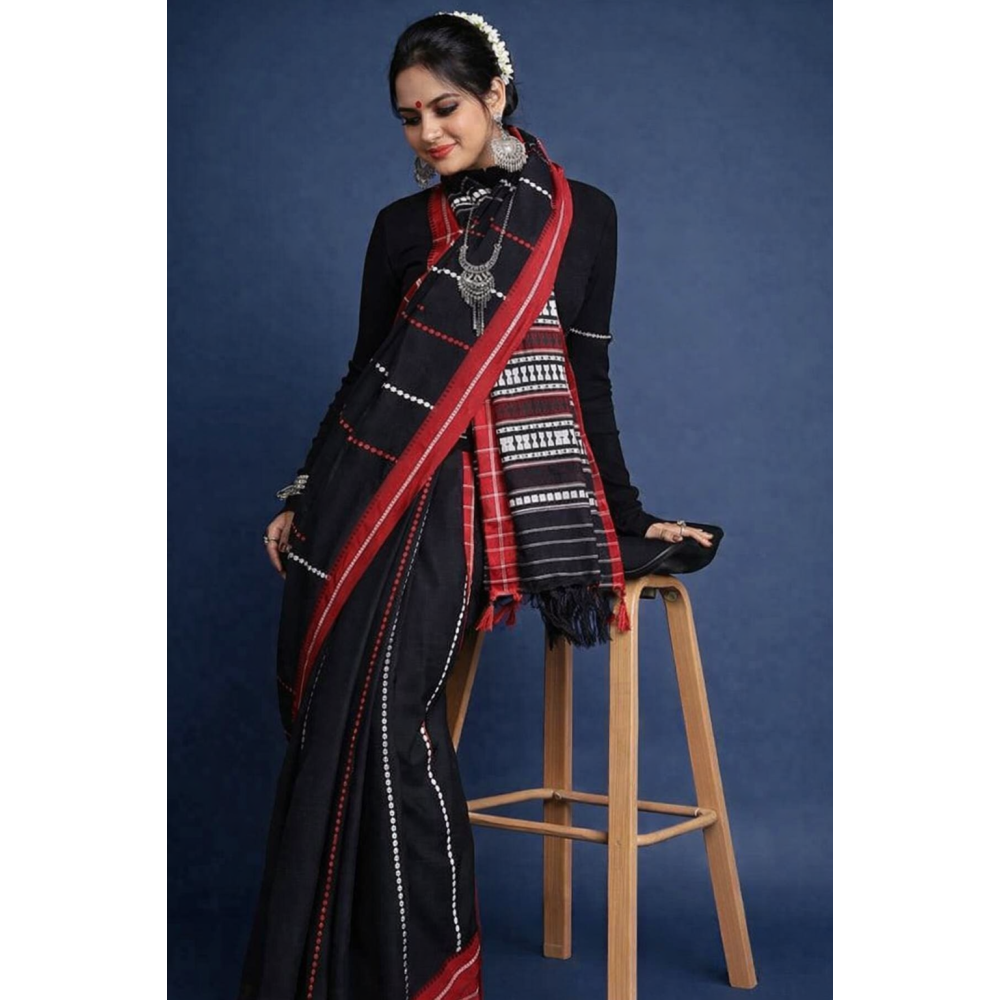

In the world of handwoven sarees, beauty is never accidental. Every line, motif, and contrast is deliberate—especially when it comes to borders and pallus. They are not merely decorative elements; they are the language through which a saree speaks.
If the body of a saree is its canvas, the border is its grammar, and the pallu is its poetry.
Across India’s handloom traditions, borders and pallus carry identity, heritage, and meaning. They tell us where a saree comes from, who wove it, and what stories it carries within its threads.
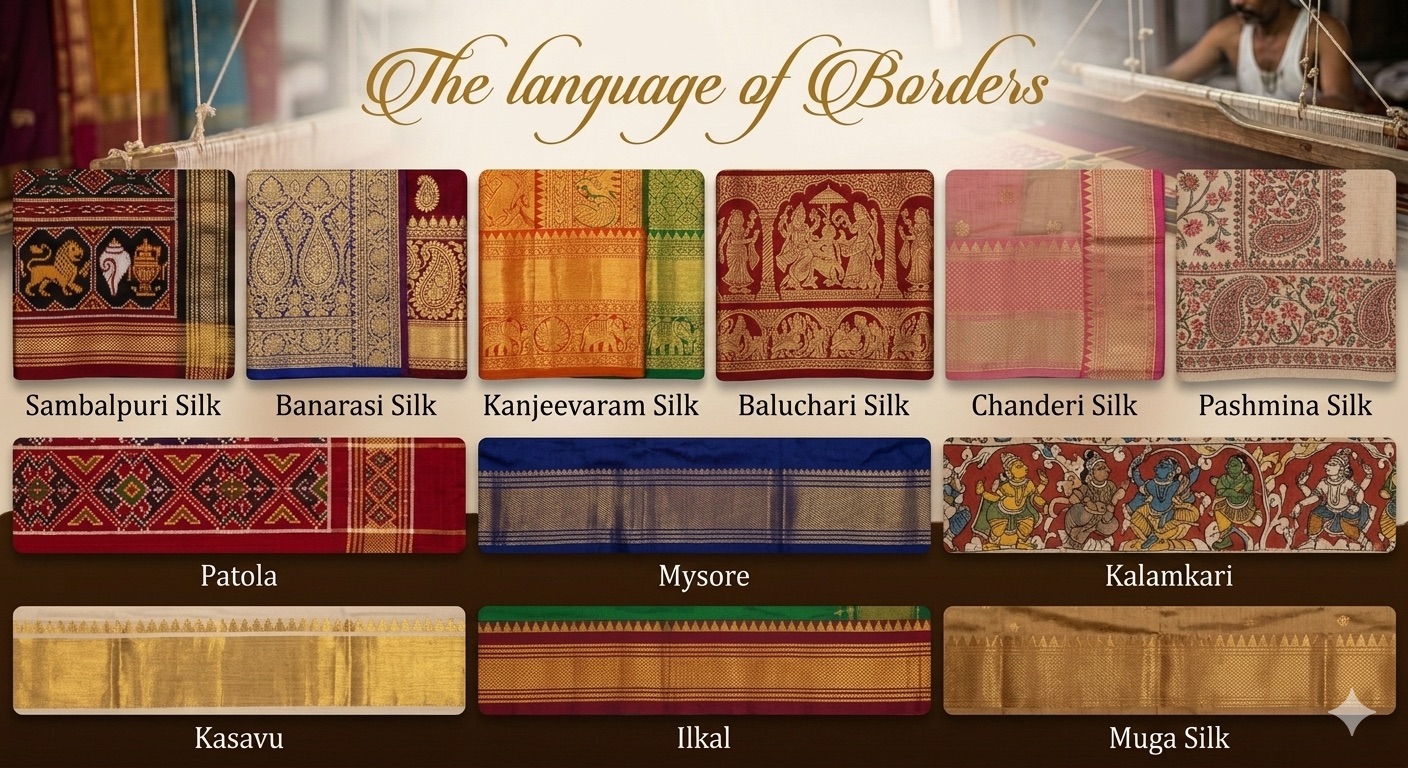
Borders: Where Structure Meets Story
A saree’s border does far more than frame the fabric. In handwoven silk sarees, borders provide strength, balance, and rhythm. Traditionally, they were designed to protect the saree from wear—especially at the edges—but over time, they became powerful markers of regional identity.
Sambalpuri Borders (Odisha)
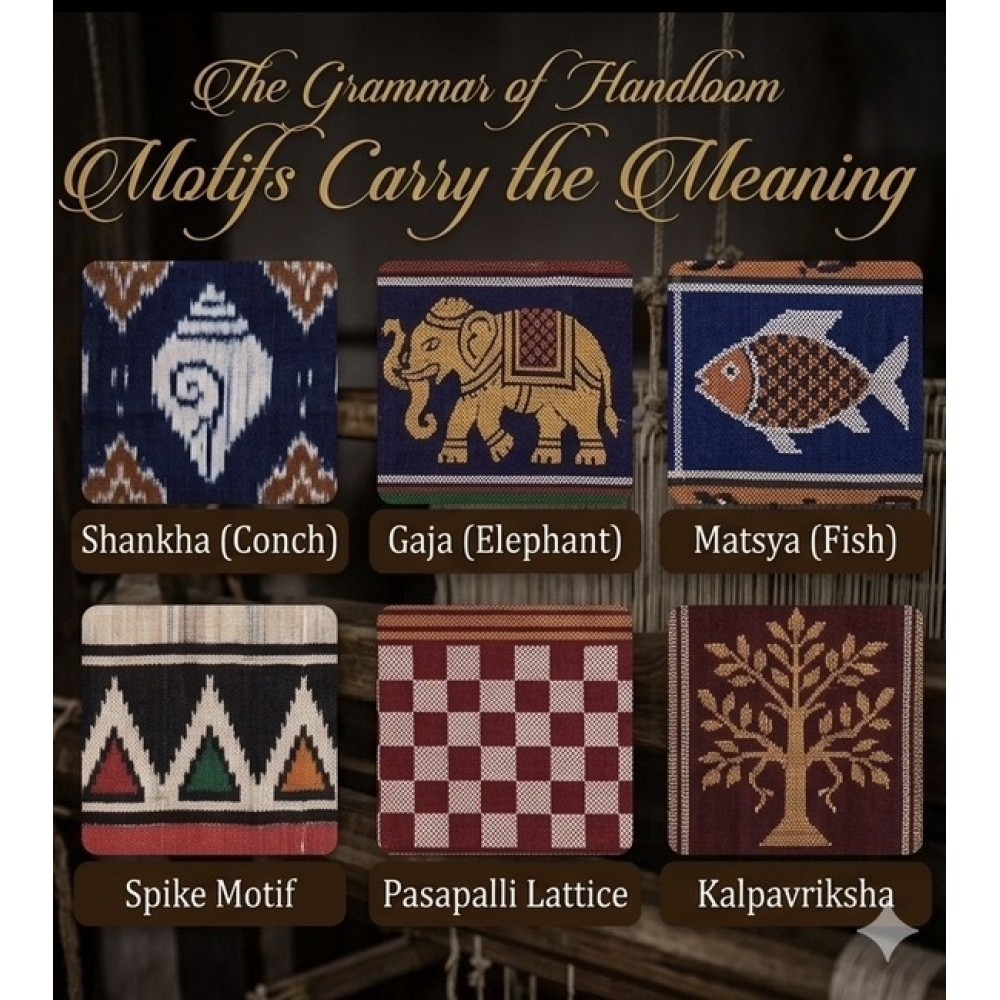
Sambalpuri saree borders are bold, symbolic, and instantly recognizable. Woven using the ikat technique, these borders often feature motifs like the shankha (conch), chakra (wheel), flowers, and temple geometry. Their sharp contrasts—red, black, white, and natural silk tones—reflect Odisha’s spiritual and architectural heritage.
These borders are not added later; they are planned from the very first thread, demanding immense precision and experience from the weaver.
Sonepur Borders (Odisha)
Sonepur silk sarees are known for their understated elegance. Their borders are balanced, refined, and quietly luxurious—often woven in silk-on-silk or with subtle zari. Rather than dominating the saree, Sonepur borders complement it, allowing the craftsmanship to reveal itself slowly.
Pochampalli Borders (Telangana)
In Pochampalli ikat sarees, borders often echo the geometric patterns of the body. The repetition and symmetry create a sense of harmony, making the saree feel structured yet fluid. These borders are mathematical, rhythmic, and deeply disciplined in execution.
Zari Borders Across India
In regions like Banaras, Kanchipuram, and Paithani, zari borders signify ceremony and celebration. When woven by hand, zari requires careful balance—too heavy, and the saree loses its drape; too light, and it loses its grandeur.
Minimal & Contemporary Borders
Modern handloom interpretations often feature slim or minimal borders, designed for contemporary wardrobes. Yet even these restrained borders uphold loom integrity, proving that tradition can evolve without losing its soul.
The Pallu: Where the Weaver Speaks
If borders give a saree structure, the pallu gives it a voice.
The pallu is where the weaver’s imagination flows freely. It is often the most time-consuming part of the saree and the space where stories unfold—through motifs, patterns, and texture.
Traditional pallus may depict:
• Mythological scenes
• Temple and architectural patterns
• Nature-inspired motifs
• Symbolic geometry and sacred forms
In Sambalpuri sarees, pallus often mirror temple traditions and spiritual symbolism. In Banarasi silks, they carry opulence and intricate zari work. In Assam silk sarees, pallus are elegant, rhythmic, and deeply connected to nature.
Some pallus are dense and dramatic; others are minimal and meditative. Both speak—just in different voices.
Motifs in Borders & Pallus: Meaning Beyond Design
In handwoven sarees, motifs are never random. They are cultural memory.
• Lotus symbolizes purity and creation
• Conch and wheel represent cosmic rhythm and continuity
• Birds and animals signify prosperity and protection
• Geometric patterns reflect balance and order
When these motifs appear in borders and pallus, they act as visual signatures—quietly telling stories that words cannot.
Why Borders and Pallus Matter Today
In an age of mass production, borders and pallus are often reduced to printed embellishments. But in true handwoven silk sarees, they remain living expressions of skill, patience, and heritage.
They reveal:
• The weaver’s mastery
• The region’s identity
• The saree’s authenticity
To notice a border, to understand a pallu, is to truly see a saree.
Preserving the Language of the Loom
When you choose a handwoven saree, you are choosing to preserve a language that is slowly fading—the language of borders and pallus woven by hand, not machines.
At Satika, we celebrate these details. Each saree is curated not just for how it looks, but for what it carries—the stories at its edges and the poetry at its end.
Because in handloom, meaning often lives in the margins.