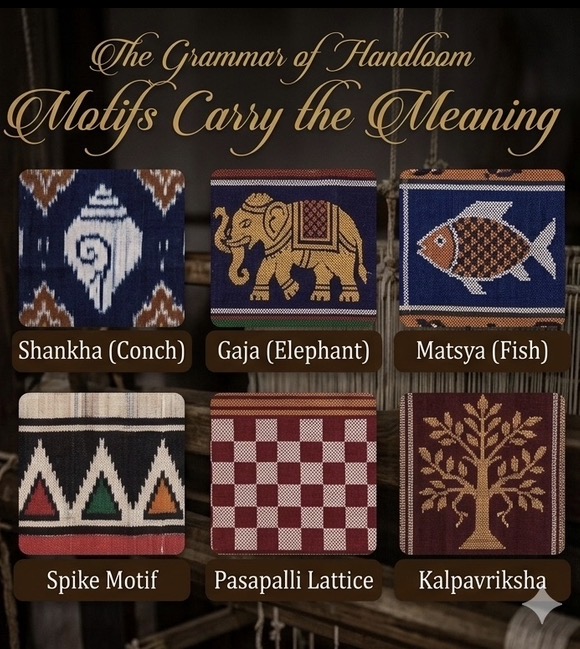
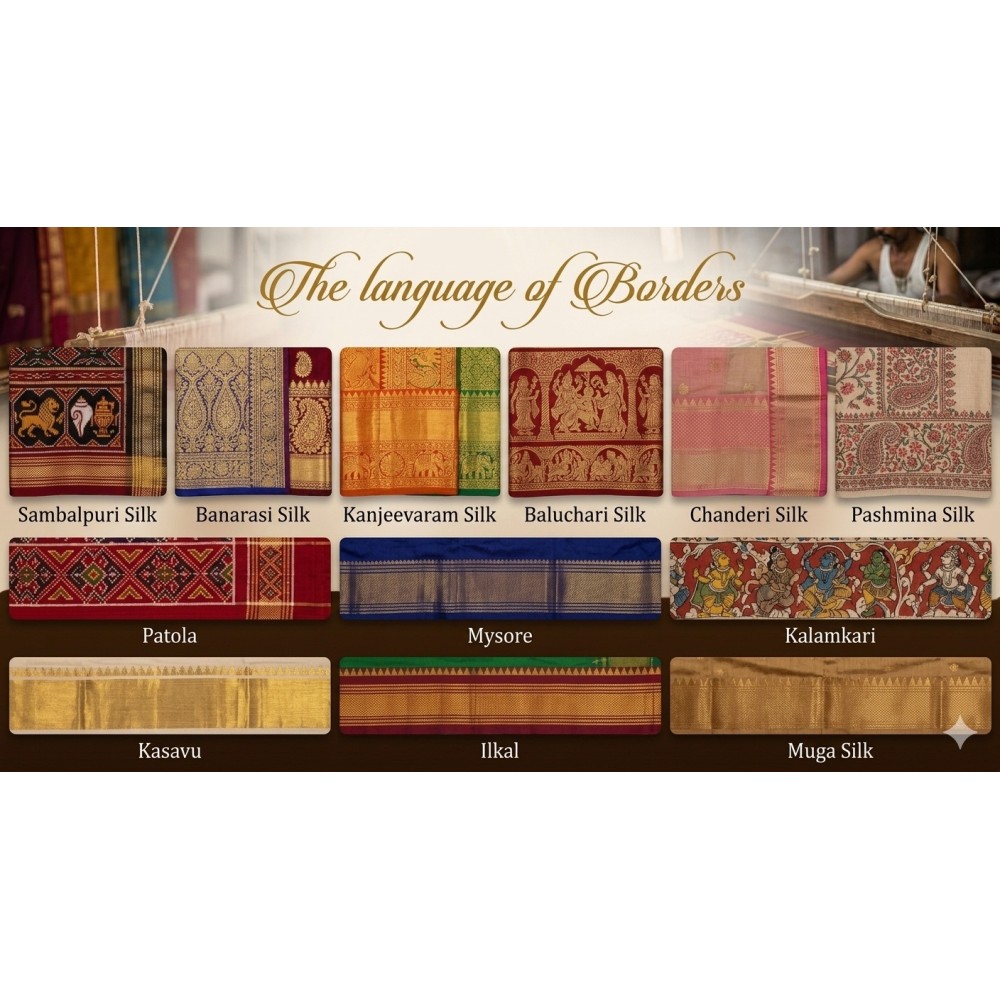
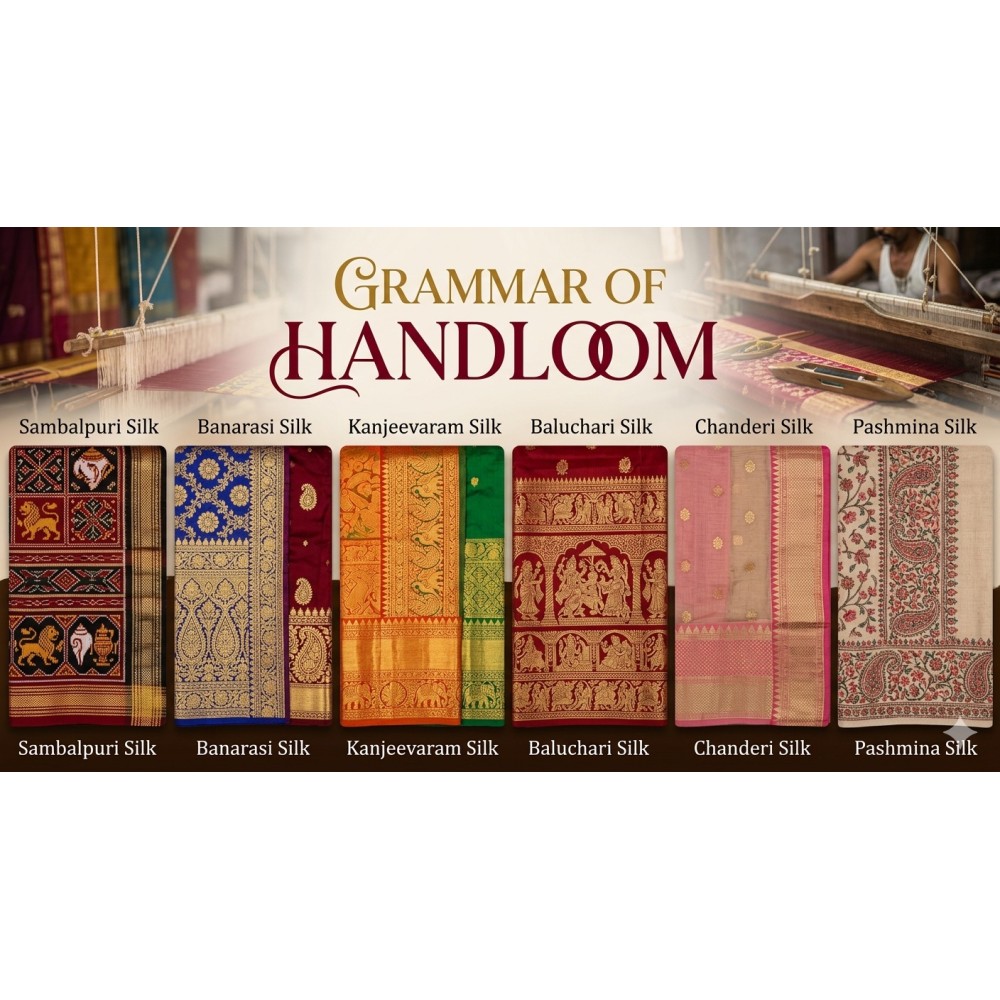
In Indian handwoven silk sarees, motifs are never mere decoration. They are symbols—quiet storytellers that carry belief, memory, and meaning across generations. Long before written records, these motifs became a language of their own, woven patiently into silk by artisans who understood that fabric could speak.
Every motif has a reason for being there. Every shape, curve, and repetition reflects a worldview shaped by nature, spirituality, and everyday life.
To understand Indian handloom is to understand its motifs.
Motifs as Cultural Memory
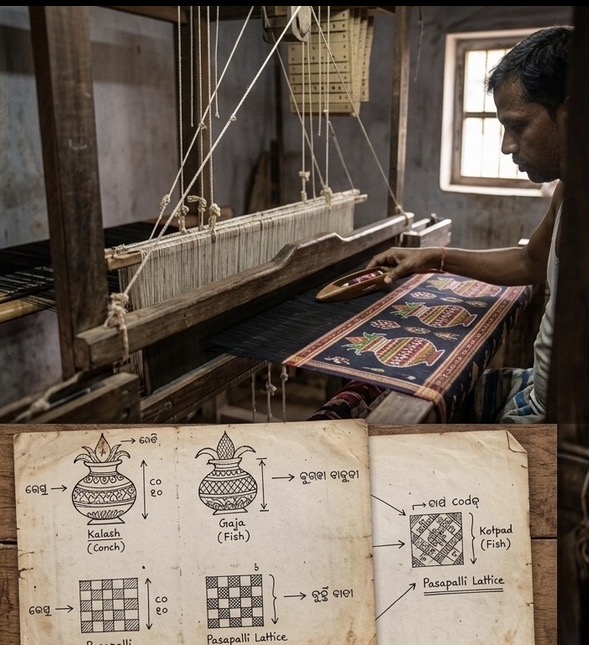
Motifs in handwoven sarees are passed down not through books, but through practice. A weaver learns them by watching, repeating, and perfecting—absorbing stories along the way. Over time, these motifs become inseparable from regional identity.
In silk sarees especially, motifs gain depth. The sheen of silk highlights every detail, making each symbol stand out with quiet authority.
Sacred Motifs and Their Meanings
Lotus (Padma)
The lotus is one of the most revered motifs in Indian textiles. It symbolizes purity, creation, and divine beauty—rising untouched from murky waters. In silk sarees, lotus motifs often appear in pallus and borders, lending the saree a serene and auspicious presence. Explore Sankha motif sambalpuri
Conch (Shankha) & Wheel (Chakra)
Common in Sambalpuri and Odisha weaves, these motifs represent cosmic rhythm, continuity, and sacred order. They echo temple traditions and spiritual philosophies, grounding the saree in devotion.
Explore Chakra motif Sambalpuri
Temple Motifs
Inspired by temple architecture, these motifs symbolize protection and permanence. Their stepped geometry reflects spiritual ascent and is often woven into borders, reinforcing the saree’s strength and structure.
Explore Temple motif Sambalpuri
Nature-Inspired Motifs
Indian weavers have always looked to nature for inspiration. Here are some nature inspired sambalpuri
Flowers & Creepers
Floral motifs represent fertility, renewal, and abundance. Creepers and vines suggest continuity—life flowing endlessly, just like the loom itself.
Birds & Animals
Peacocks, elephants, fish, and deer appear frequently across regions. These motifs symbolize grace, prosperity, protection, and harmony with nature. In silk sarees, they are often stylized, blending realism with rhythm.
Geometric Motifs: Order and Balance
Geometry plays a powerful role in Indian handloom. Diamonds, checks, lines, and repetitive forms create visual balance and meditative rhythm.
In ikat traditions like Sambalpuri and Pochampalli, geometric motifs demand extreme precision. Since threads are dyed before weaving, the motif must be imagined perfectly in advance—requiring experience, patience, and deep understanding of the loom.
Regional Motifs and Identity
• Sambalpuri Sarees feature motifs inspired by temples, shells, wheels, and tribal geometry
• Pochampalli Ikat is known for bold, mathematical symmetry
• Assam Silk Sarees reflect nature—leaves, flowers, and organic flow
• Kotpad-inspired designs carry earthy forms rooted in forest life
Each region tells its own story, yet all are united by the loom.
Motifs in Contemporary Handloom
Today, handloom motifs are evolving gently. While rooted in tradition, weavers experiment with scale, spacing, and placement—making sarees suitable for modern wardrobes without losing their soul.
A single motif, placed thoughtfully, can say more than a crowded pattern. This balance between tradition and restraint defines contemporary luxury in handwoven silk.
Why Motifs Matter Today
In a time when designs are often printed, replicated, and mass-produced, handwoven motifs stand apart. They carry the mark of the human hand—the slight variations that prove authenticity.
Motifs remind us that handloom is not just about fabric; it is about memory, identity, and continuity.
Weaving Stories Forward
When you wear a handwoven silk saree, you carry more than silk. You carry stories—of nature, devotion, craftsmanship, and time itself.
At Satika, we curate sarees where motifs are honoured, not diluted. Each piece is chosen for the story it tells and the tradition it sustains. Because in Indian handloom, every motif is a voice—and together, they form a timeless conversation.