
Understanding the Structure, Soul & Story of Silk Sarees
In every language, grammar gives structure to expression. It defines how words come together, how meaning is formed, how emotion is conveyed.
Handloom has its own grammar.
Every silk saree woven on a loom follows an unspoken structure — a carefully balanced composition of body, border, and pallu. These elements are not decorative afterthoughts. They are deliberate decisions made before the first thread is set. They define identity. They shape beauty. They carry tradition forward. Click here to explore Satika
To understand a handwoven silk saree is to understand its grammar.
What Is the Grammar of Handloom?
The grammar of handloom is the system of rules, rhythm, balance, and placement that governs how a saree is woven.
It includes:
- The alignment of warp and weft
- The structure of the border
- The narrative of the pallu
- The placement of motifs
- The harmony of colour
Just like a sentence collapses without structure, a saree loses integrity without thoughtful composition.
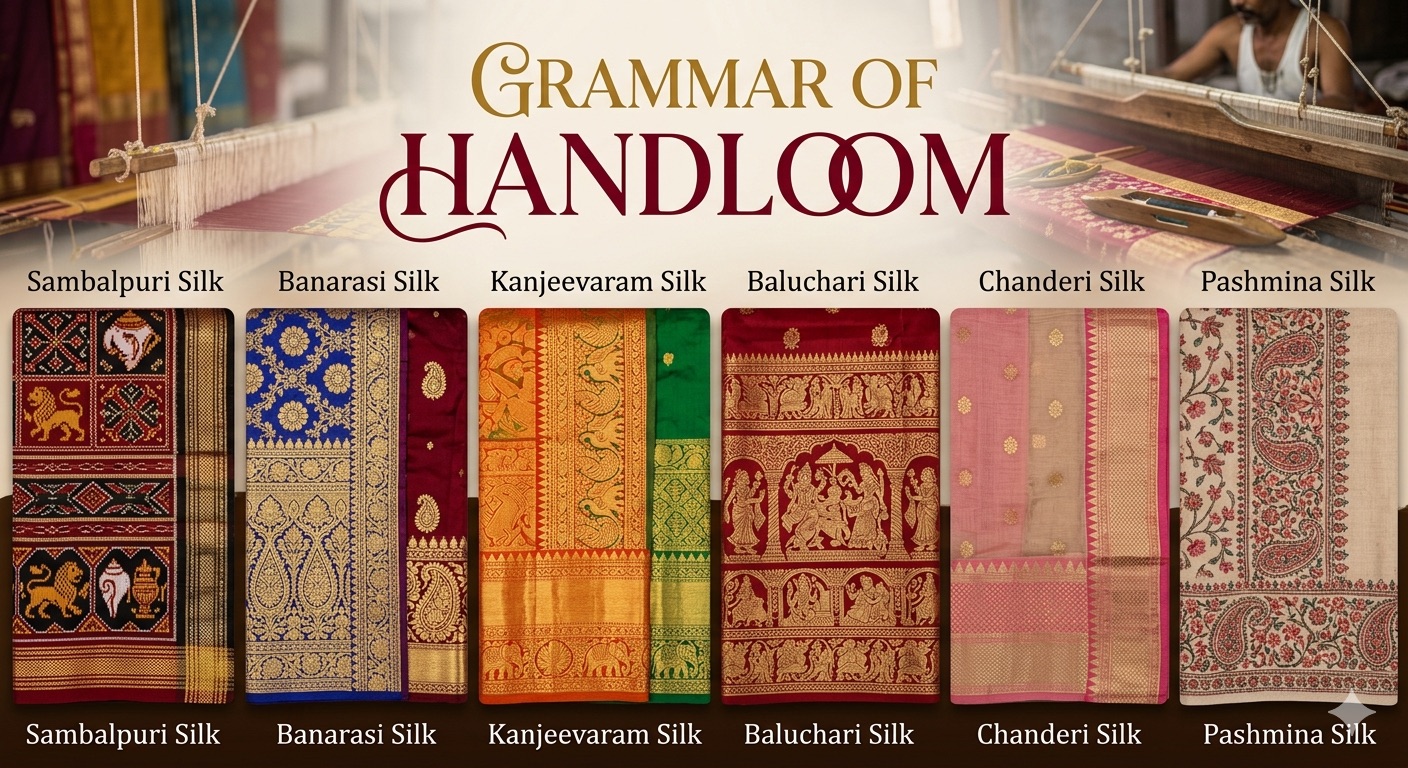
In silk handloom weaving — especially in Sambalpuri Patta silk — precision is everything. Every motif must align. Every border must balance. Every colour must converse with the other.
Nothing is accidental.
The Body: The Foundation of Expression
The body of a silk saree is like the main paragraph in a story. It carries the primary emotion.
In Sambalpuri silk handloom sarees, the body often features:
• Ikat motifs
• Temple-inspired geometry
• Floral abstractions
• Symbolic forms like conch and wheel
The body determines whether a saree feels bold, minimal, ceremonial, or contemporary. A heavily patterned body speaks loudly. A restrained one whispers with elegance.
Grammar begins here
The Border: The Frame of Identity
If the body is the story, the border is the punctuation.
Borders in silk handloom sarees serve both structural and aesthetic purposes. They strengthen the edges while defining the saree’s personality.
Temple Borders
Inspired by sacred architecture, these stepped designs symbolize protection and continuity.
Ikat Borders (Sambalpuri)
Featuring geometric precision, shankha, chakra, or stylized florals — these borders demand technical mastery.
Zari Borders
In silk sarees, zari introduces luminosity. It transforms the saree into occasion-wear, adding ceremonial richness without overwhelming the weave.
A saree is often remembered by its border long after it is folded away.
The Pallu
Where the Weaver Signs Their Name
The pallu is the most expressive section of a saree.
This is where artistry reaches its peak. It is where motifs become more elaborate, where symmetry becomes storytelling.
In handwoven silk sarees, pallus may feature:
• Dense ikat grids
• Mythological symbolism
• Temple architecture
• Nature-inspired narratives
Weaving a pallu requires planning long before the loom begins. It demands clarity, skill, and patience.
The pallu is not an ending — it is the climax.
Motifs: The Vocabulary of Silk
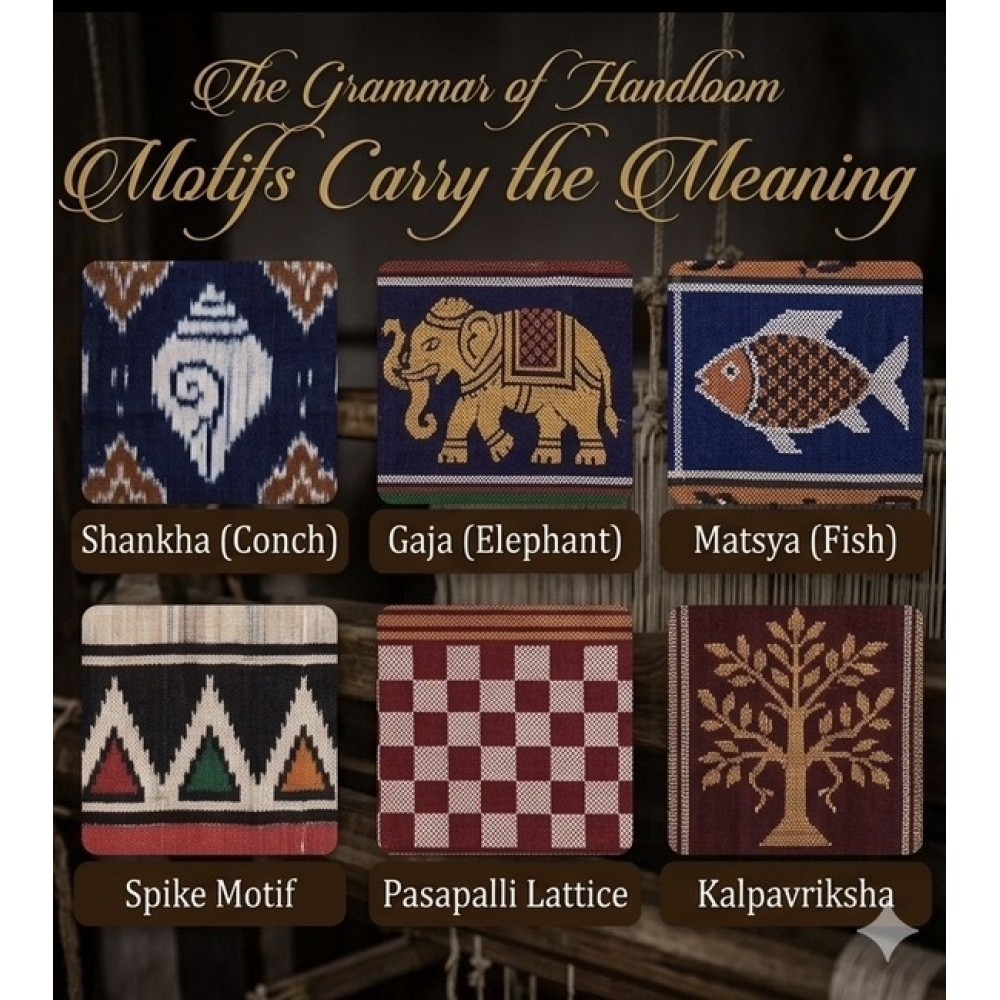
Motifs are the words in the grammar of handloom.
Each carries meaning:
• Lotus for purity and rebirth
• Conch for sacred sound and rhythm
• Wheel for cosmic continuity
• Floral vines for growth and prosperity
In Sambalpuri silk, motifs are dyed into threads before weaving — a technique requiring foresight and exact alignment. One mistake can distort the entire pattern.
This is where handloom separates itself from imitation.
Colour as Syntax
Colour in handloom silk is never random.
Traditional combinations like:
• Red and black
• Deep blue and white
• Maroon and mustard
• Ivory and gold
These combinations are cultural memory. They signal region, ritual, and heritage.
In silk, colour gains depth. It absorbs light differently. It matures with time.
The grammar of handloom includes knowing when to contrast and when to harmonize.
Why Grammar Matters in Luxury
True luxury is not loud.
It is thoughtful. Balanced. Intentional.
When a saree follows the grammar of handloom, it drapes better. It feels composed. It carries quiet authority.
Mass production ignores grammar. Handloom preserves it.
And that preservation is what makes silk sarees heirlooms rather than garments.
The Responsibility of the Wearer
When you choose a handwoven silk saree, you choose to honour this grammar.
You choose:
• Craft over convenience
• Patience over speed
• Meaning over trend
At Satika, every silk saree is selected with respect for structure, artistry, and heritage. We believe that beauty lies not just in appearance — but in composition.
Because when grammar is respected, elegance becomes timeless.